Every unit built right, and on the record.
Flux is manufacturing execution for electronics and connected devices. Work orders arrive from Logik, stations run versioned lines and sign every result, and each unit leaves with its full genealogy and a signed hand-off.
Pilots are set up with your first line by our team.
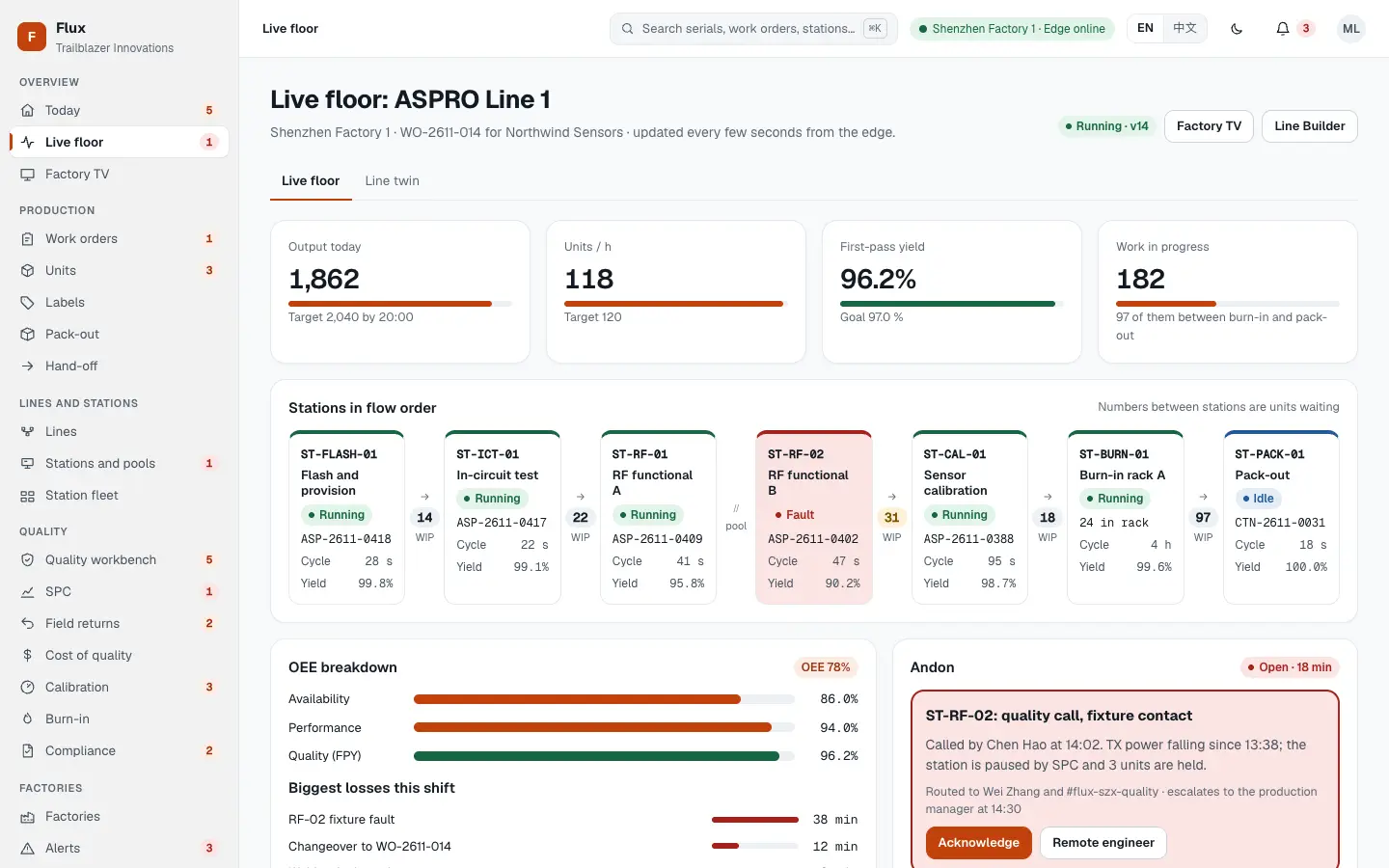
The floor should not be the place where records go missing.
Test scripts on a station PC, results in CSV files nobody can find.
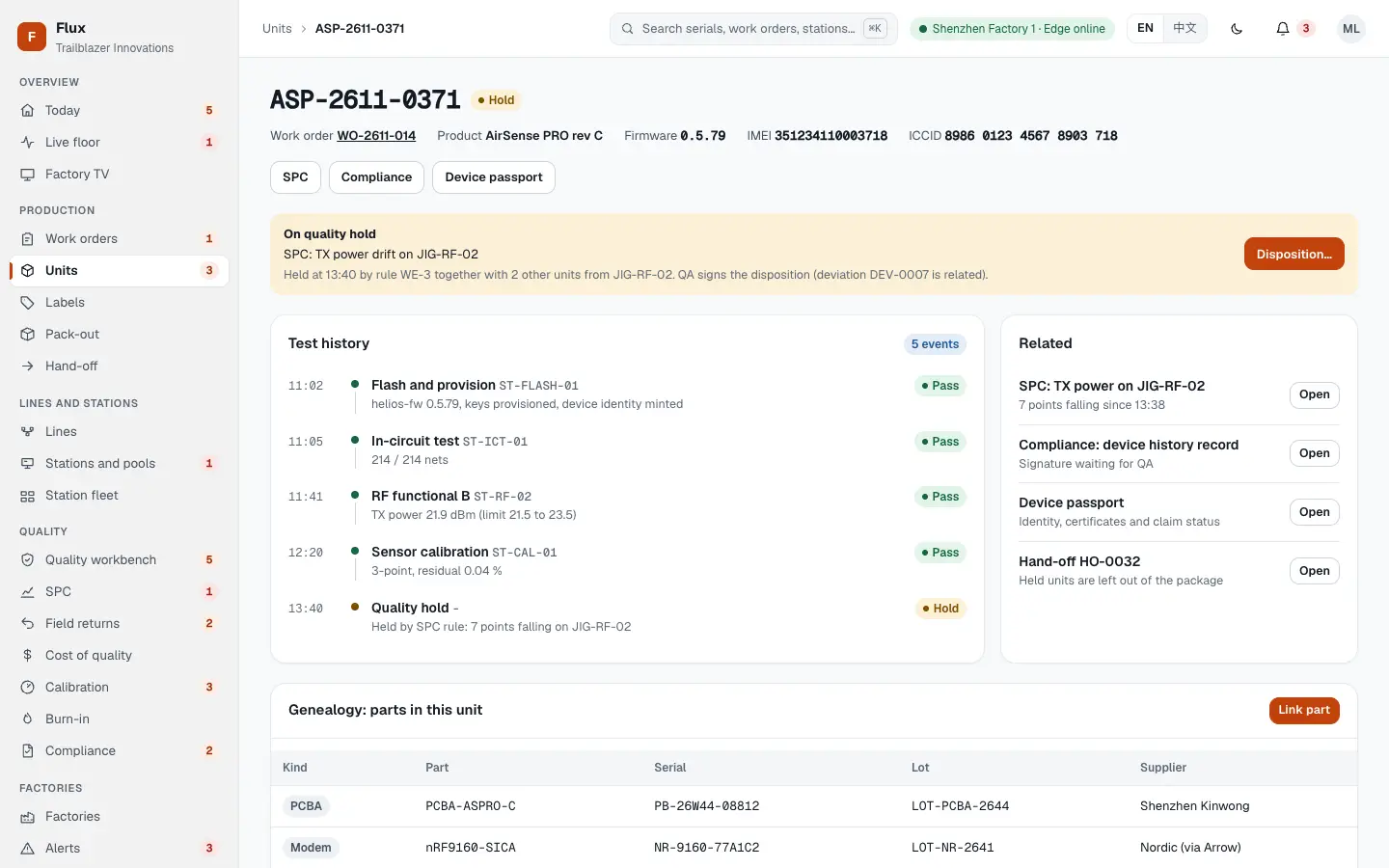
Stations post signed results to Flux, stored against the unit’s serial.
A line is a folder of scripts, and nobody knows which version built which unit.
Lines are versioned data. Each work order pins the line version it ran on.
A customer asks for yield, holds and certificates, and someone builds a spreadsheet.
The client portal shows them their own work orders, yield and certificates.
Devices ship, and their identities are re-entered into the cloud by hand.
A signed hand-off package carries unit identities to the customer’s fleet in Console.
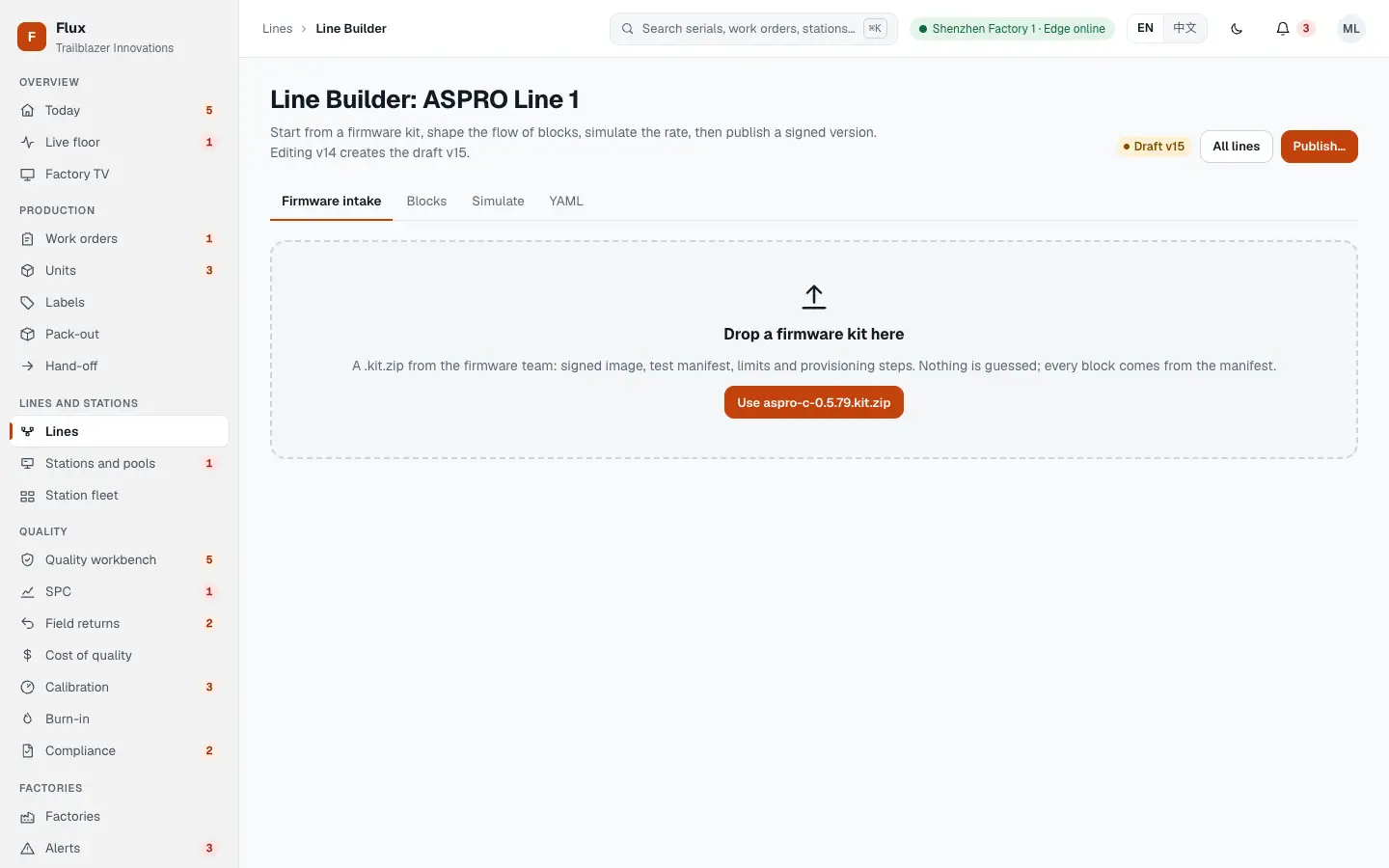
Lines are versioned data, not a folder of scripts.
Build a line in the block editor or start it from the firmware kit your team published. Simulate it, publish it, and every work order pins the exact line version it ran on. Each organization can run any number of lines, one per product, each with its own serial pattern.
- New line from firmware from the helios catalog
- Simulate before publish, and a dry-jig run per station
- Station pools for parallel test
- Rollouts and limit changes approved by someone other than the author
Every result signed by the station that produced it.
Stations run helios station files and post signed unit results to Flux. Each unit keeps its test history, parts, firmware, rework attempts and identities such as IMEI, ICCID and certificate fingerprint.
- Unit detail: test timeline, parts, identities, holds
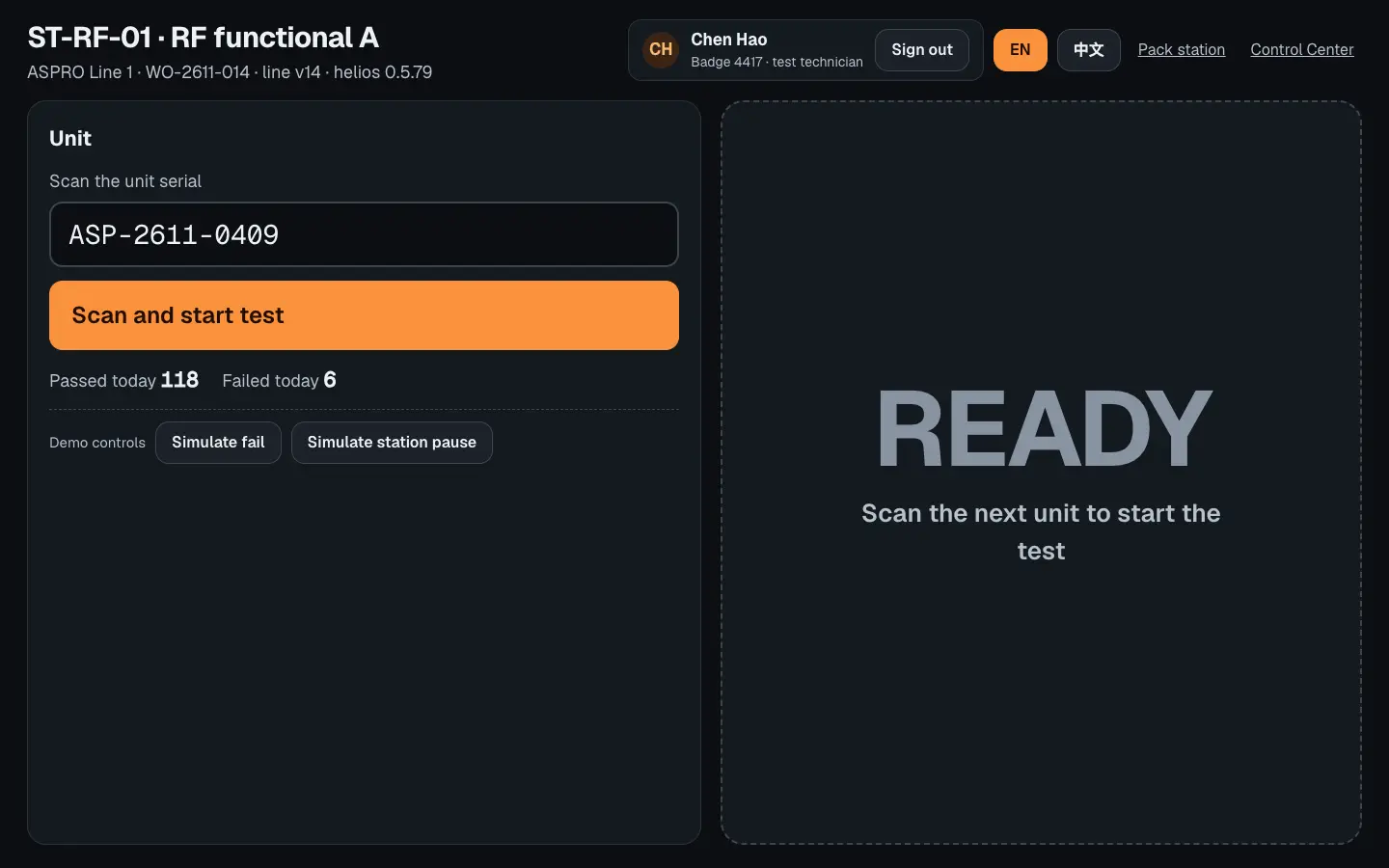
- Operator kiosk: scan, test, pass or fail, with badge and PIN
- Labels printed at the station
- Cellular SIM activation at the station (provider-specific, in pilot)
Catch drift before units fail.
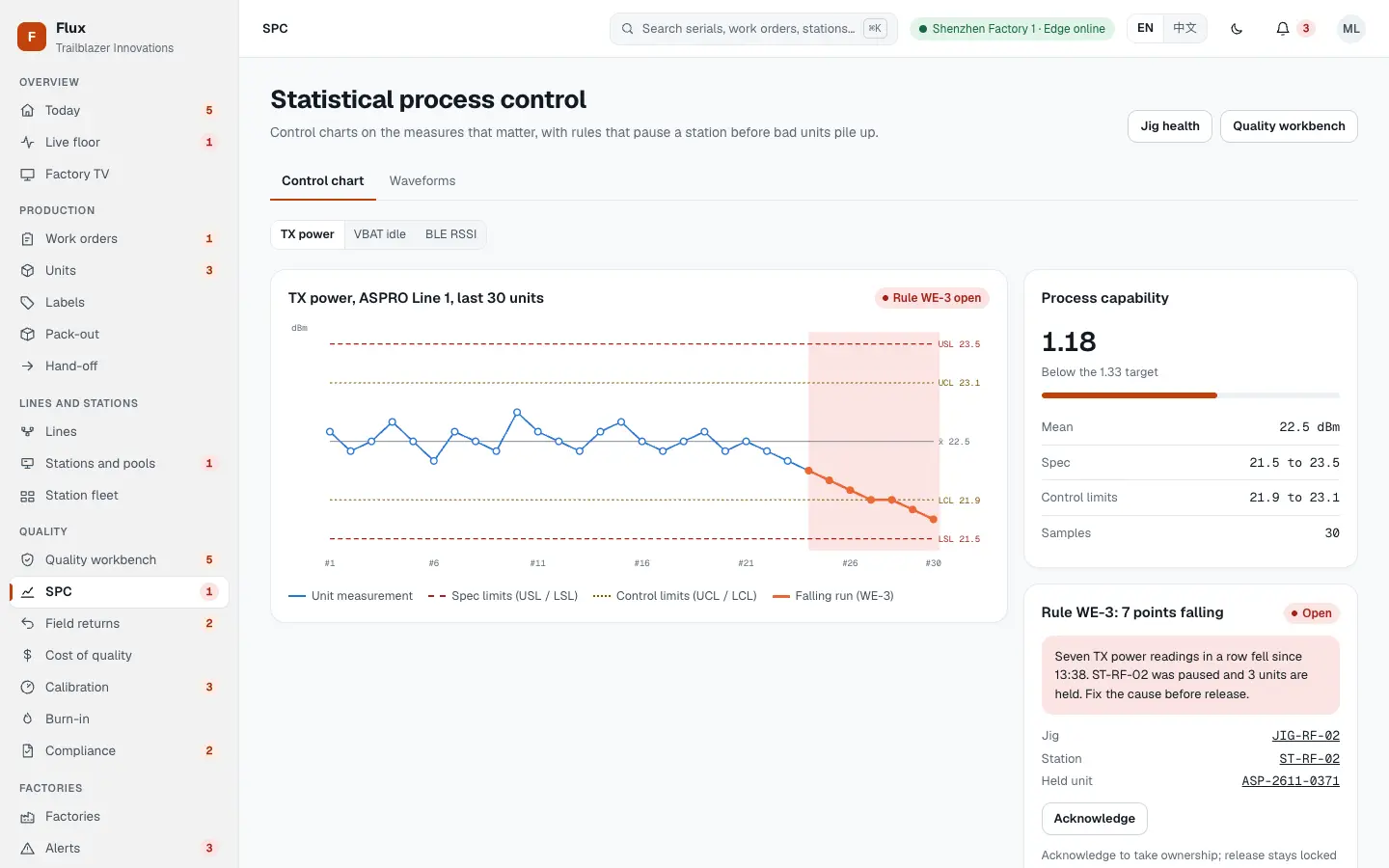
The quality workbench brings yield, failures, SPC, field returns and cost of quality to one place. Holds and rework keep bad units away from customers, and scrap always needs a second person.
- SPC with control limits per measurement
- Failure Pareto and analysis on the top failure
- Field returns tied back to the build
- Cost of quality per line
Ship the unit and its paperwork together.
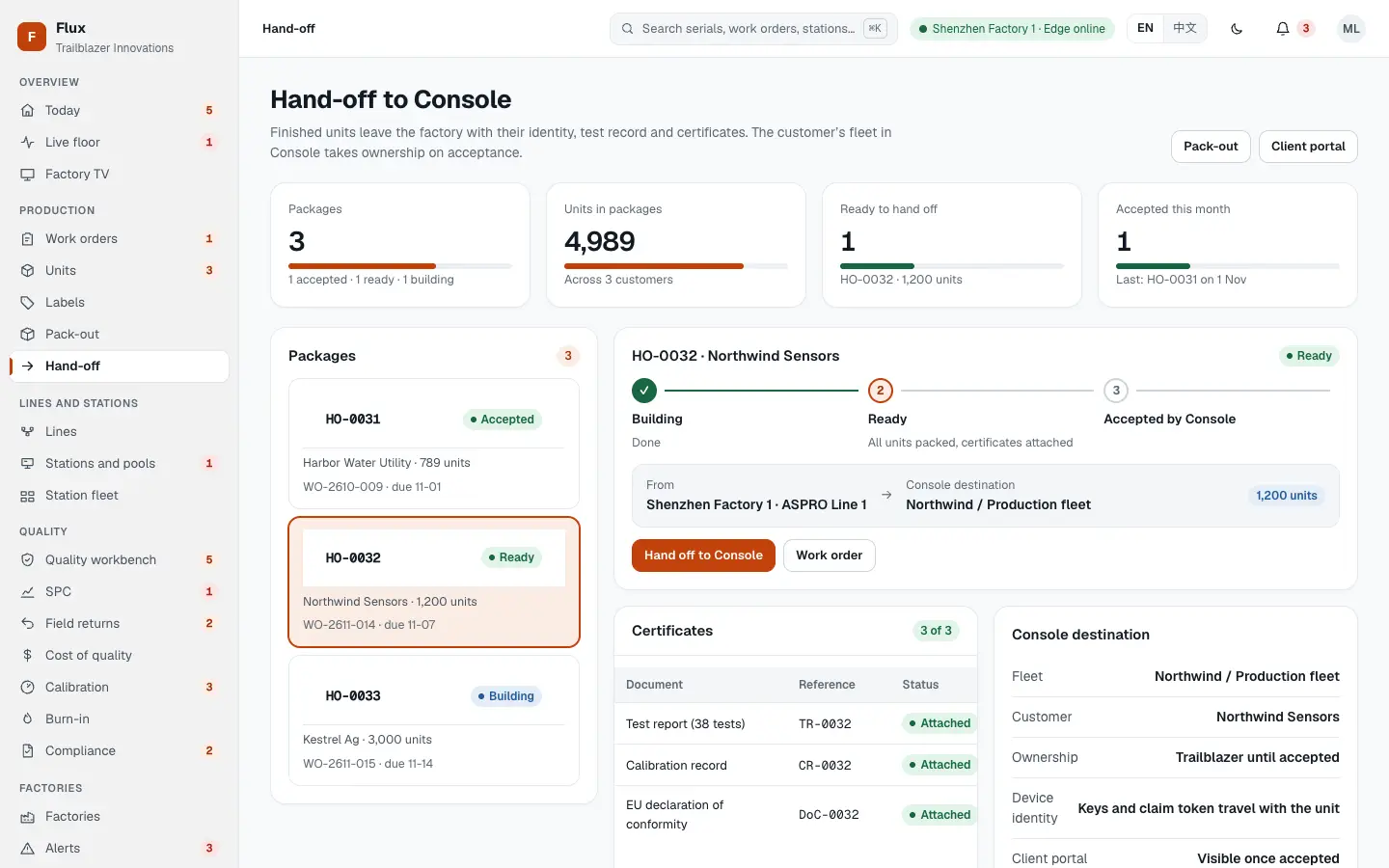
Pack-out records which serial is in which box and pallet. A signed hand-off package and the unit identities go to the customer’s fleet in Console, and the buyer claims each device with its passport. Customers see yield, holds and certificates in their own portal.
- Signed hand-off package per shipment
- Device passport the buyer uses to claim a unit
- Client portal with yield, holds and certificates
- Results and pack-out flow back to the Logik build
Everything a production manager checks before 9 a.m.
Today and live floor
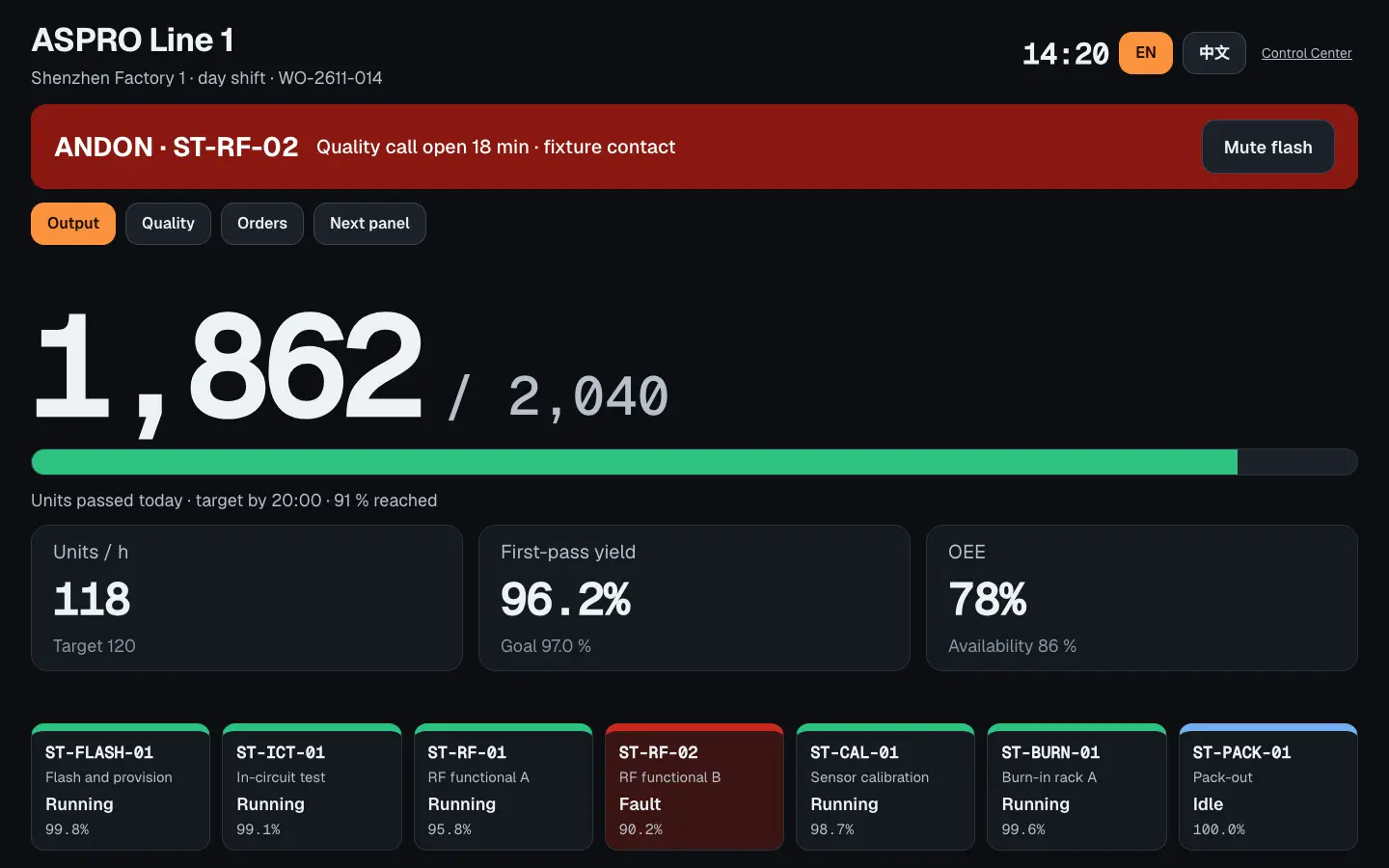
Output against target, first-pass yield, holds and the bottleneck station, with a Factory TV view for the wall.
Andon and alerts
Station andon, recommended alert rules, acknowledgement and resolution notes.
Labels and pack-out
Unit, box and pallet labels; which serial is in which box and pallet.
SPC and Pareto
Control charts and failure Pareto per line, with drift flagged before units fail.
Holds, rework and MRB
Release, rework or scrap, and scrap always needs a second person.
Calibration and burn-in
Due dates for fixtures and instruments, burn-in runs recorded per unit.
Operator kiosk
Badge and PIN sign-in at the station, scan and start test, no Control Center account needed.
Remote engineer
An engineer elsewhere can follow a failing station and the unit history.
Flux Edge for offline lines
The same build on a factory Raspberry Pi with a local database; it downloads work orders before a trip and uploads results when online.
Between the order and the fleet.
Flux receives the build from Logik and hands finished, identified units to Console. Results, pack-out and reports are reachable from both.
-
Logik
Sell and plan
- RFQ and BOM-priced quote
- Proposal, MSA and SOW, signed
- Sales order, build, kit and purchase orders
Released build arrives as a work order with serials, firmware and the parts kit
-
Flux
Build and prove
- Work order on a versioned line
- Program and test, results signed per unit
- Pack-out, labels and a signed hand-off
Unit identities and the hand-off package go to the customer’s fleet
-
Console
Operate
- Devices claimed into the customer’s AWS
- Health, telemetry, incidents, commands
- Staged firmware rollouts
Device counts come back as metered lines on Logik invoices
Connected to the systems that matter on a line.
Available an organization can connect it today · In pilot working with pilot customers · Coming soon built, being switched on · On the roadmap not built yet
Core Part of how the platform works, end to end.
-
Logik
AvailableReleased builds arrive as work orders with serials, firmware and the kit; results and pack-out flow back
Platform -
Console
AvailableSigned hand-off package and unit identities to the customer fleet
Platform -
helios station files
AvailableStations run helios YAML flows and post signed unit results
Floor -
Label printers
AvailableUnit, box and pallet labels from the label designer
Floor -
Trailblazer ID
AvailableOne sign-in across Logik, Flux and Console
Security -
Slack and email alerts
Coming soonAndon and quality alerts to the right channel
Work
Add-ons Optional connectors an organization switches on when it needs them.
-
Cellular providers
In pilotAutomatic, provider-specific SIM activation at the station
Floor
Flux versus scripts and spreadsheets.
We have not published a vendor-by-vendor MES comparison yet; this compares Flux with the most common starting point for small hardware lines.
| On the line | Station scripts + spreadsheets | Flux |
|---|---|---|
| Which line version built this unit | Whatever was on the PC that day | Pinned on the work order |
| Test results | Local files per station | Signed by the station, stored per serial |
| Scrap and limit changes | One person decides | A second person approves |
| Customer reporting | Built by hand | Client portal with yield, holds and certificates |
| Device identities to the cloud | Re-entered or uploaded as CSV | Signed hand-off to Console |
| Offline factory | Works, but nothing syncs | Flux Edge syncs results when online |
Floor credentials reach only their own station.
- Trailblazer ID sign-in for the Control Center, with roles such as production manager, quality engineer, engineer, operator, partner factory and customer viewer.
- Separation of duties: nobody approves their own scrap, rollout or limit change.
- Signed station results with per-station secrets.
- Customers see only their own records in the client portal.
- AI is optional: features such as failure hints are off by default.
- Runs on AWS (us-east-2), or on site with Flux Edge.
Flux FAQ
What is Flux?
Flux is manufacturing execution (MES): it runs and records the building of your devices, from the work order to the signed hand-off.
Is Flux available today?
Flux is deployed and offered as a guided pilot: our team sets up your first line with you. There is no self-serve sign-up for Flux yet; request a demo to start.
Do I need Logik to use Flux?
Flux is designed to receive work orders from Logik, and the pilot runs with both. Talk to us if you run another ERP.
What do my stations need to run?
Stations run helios station files (YAML flows) that post signed unit results to Flux. A factory without reliable internet can run Flux Edge on a Raspberry Pi 5 on site.
Is Flux validated for regulated manufacturing?
Flux records electronic signatures and dispositions with separate approvers, but we do not claim certification under any specific regulation. Discuss your requirements with us.
How is Flux priced?
As a platform subscription through Logik billing. Pilot pricing is agreed per customer; we do not publish a price yet.
See Flux on your own product.
Tell us what you build and how you test it today. We will show Flux on a line like yours and explain how a pilot runs.
- A walkthrough with the people who build Flux
- Your first line set up with you in the pilot
- No commitment, no card